






Recovering outstanding payments is an important part of maintaining a healthy cash flow and ensuring business stability. In Dubai, businesses frequently deal with unpaid invoices, overdue commercial debts, delayed payments, and customers who fail to meet their contractual obligations. When repeated reminders and direct negotiations do not produce results, professional debt recovery assistance may help creditors identify suitable options for recovering the money owed.
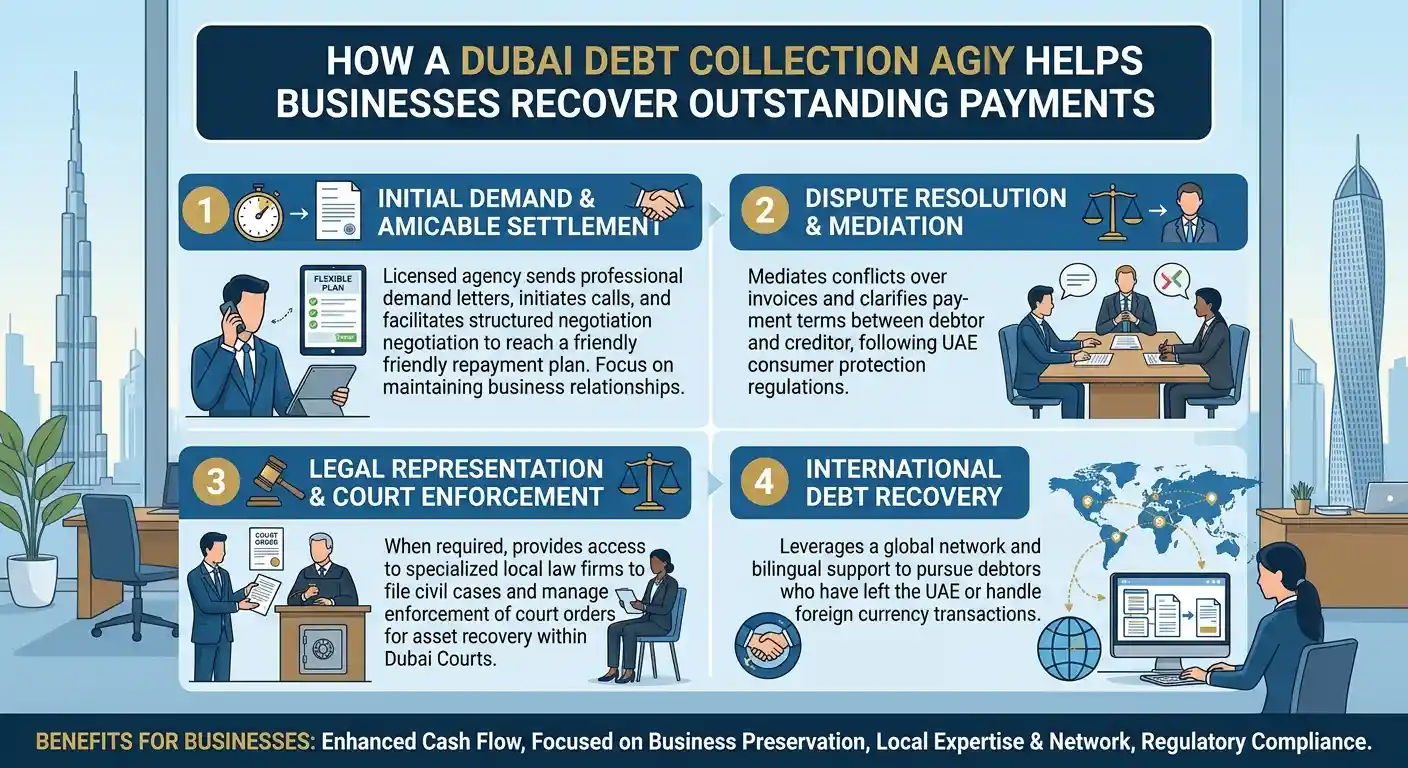
A Debt collection agency Dubai can assist businesses with reviewing outstanding accounts, contacting debtors, negotiating repayment arrangements, maintaining collection records, and coordinating further recovery steps where appropriate. Professional assistance can be particularly valuable for companies managing multiple overdue accounts or dealing with complicated commercial relationships.
However, businesses should understand how debt collection works, what services an agency provides, and which legal considerations apply before engaging a collection provider. The following FAQ explains how a debt collection agency can support businesses in Dubai and what creditors should consider when pursuing unpaid debts.
- What Services Does a Debt Collection Agency Dubai Provide?
A debt collection agency generally assists creditors with recovering money owed by individuals, companies, or other entities. The specific services available depend on the provider’s capabilities, contractual arrangements, and applicable UAE requirements.
Common services may include reviewing overdue invoices, contacting debtors, sending payment reminders, conducting collection negotiations, monitoring repayment commitments, and preparing reports about recovery progress.
For example, a Dubai-based trading company may have several customers who have failed to pay invoices despite receiving repeated reminders. A collection provider can review the outstanding accounts, organize the supporting documentation, and establish a structured follow-up process.

Some providers also coordinate with legal professionals when negotiations fail and formal legal proceedings may be appropriate. However, an agency’s authority to perform particular activities depends on the applicable rules and its professional status. Legal representation and court proceedings may require appropriately authorised lawyers.
Businesses should request a clear explanation of the services included in the agreement before appointing a collection provider.
- When Should a Business Hire a Debt Collection Agency?
Businesses should consider professional collection assistance when an invoice becomes overdue and ordinary internal collection efforts are unsuccessful.
Early action can help creditors identify payment problems before outstanding balances become more difficult to recover. Nevertheless, the appropriate timing depends on the payment terms, the debtor’s circumstances, the amount involved, and the available evidence.
Common reasons for hiring a collection provider include:
- Customers repeatedly ignoring payment reminders.
- Commercial invoices remaining unpaid beyond the agreed deadline.
- Debtors making promises to pay but failing to honour them.
- Disputes concerning outstanding balances or contractual obligations.
- Multiple overdue accounts creating administrative pressure.
- Difficulty communicating with debtors based outside the creditor’s immediate location.
A Debt collection agency Dubai may help businesses introduce a more consistent recovery process while allowing employees to focus on their ordinary responsibilities.
Creditors should not automatically assume that every delayed payment requires formal legal action. Sometimes, a payment plan or negotiated settlement may provide a practical solution.
- Can a Debt Collection Agency Recover Commercial Debts?
Yes, collection providers may assist businesses with commercial debt recovery, subject to their authority and the applicable legal requirements.
Commercial debts can arise from unpaid invoices, supply agreements, service contracts, outstanding business loans, distribution arrangements, and other transactions involving goods or services.
For example, a supplier may deliver products to a retailer under an agreement requiring payment within 30 days. If the retailer fails to pay, the supplier can review the contract, delivery records, invoices, and communications to establish the amount outstanding.
A collection provider can then contact the debtor, request payment, and explore settlement options.
The strength of the creditor’s documentation is an important factor in commercial recovery. Signed contracts, purchase orders, delivery confirmations, account statements, and written acknowledgements of the debt may help demonstrate the basis of the claim.
If the debtor disputes the amount or refuses to pay, the creditor may need advice from a qualified UAE legal professional regarding the available legal remedies.
- What Documents Are Required for Debt Collection in Dubai?
The documents required depend on the type of debt, the contractual relationship, and the circumstances surrounding non-payment.
Businesses should generally prepare the following records where applicable:
- Signed contracts or service agreements.
- Original invoices and statements of account.
- Purchase orders and delivery confirmations.
- Payment records showing amounts already received.
- Emails, letters, and messages concerning payment.
- Written acknowledgements of the outstanding balance.
- Relevant settlement agreements or repayment schedules.
- Information identifying the debtor and the responsible business entity.
A Debt collection agency Dubai can review these documents to understand the amount claimed, the payment terms, and any potential disagreements.
Creditors should ensure that their calculations are accurate and that all relevant payments or credit notes have been considered. Incorrect balances or incomplete records can complicate negotiations and may weaken a recovery claim.
If documents are in another language or were issued in a foreign jurisdiction, additional translation, authentication, or legal review may be necessary depending on the intended use.
Businesses should also retain original records and provide copies through appropriate secure channels.
- Can a Debt Collection Agency Negotiate Payment Plans?
Yes. Negotiating a repayment arrangement can be an important part of the debt recovery process.
Some debtors acknowledge that money is owed but cannot pay the full amount immediately because of temporary cash-flow difficulties. In these circumstances, an agreed instalment plan may allow the creditor to recover the debt without immediately pursuing more formal remedies.
A Debt collection agency Dubai may communicate with the debtor, assess proposed payment terms, and help facilitate discussions between the parties.
For example, a business owing AED 60,000 might propose paying AED 15,000 immediately and the remaining balance in three monthly instalments. Whether the creditor accepts this proposal depends on its commercial priorities, the debtor’s reliability, and the terms of the original agreement.
Any settlement should clearly state the amount payable, instalment dates, payment method, and consequences of missed payments, where legally appropriate.
Creditors should obtain suitable legal advice before agreeing to significant compromises, waiving claims, or changing contractual rights. A properly documented arrangement can reduce misunderstandings and provide a clearer basis for further action if the debtor fails to comply.
- What Happens If a Debtor Refuses to Pay?
If a debtor refuses to pay despite reasonable collection efforts, the creditor may need to consider further options.
The appropriate response depends on the evidence, the nature of the debt, the applicable limitation periods, the contractual terms, and the competent court or dispute-resolution mechanism.
Potential next steps may include a formal demand for payment, further settlement negotiations, legal proceedings, or enforcement measures where the creditor obtains an enforceable title and satisfies the relevant legal requirements.
A Debt collection agency Dubai may help organise the collection history and supporting documents, but an agency cannot automatically compel a debtor to pay or seize assets simply because money is outstanding.
Where litigation is appropriate, a qualified lawyer can assess the claim, advise on jurisdiction and procedure, and explain the likely costs and risks.
Businesses should act promptly when an account becomes seriously overdue. Delays can create practical difficulties, and applicable limitation periods may affect the ability to pursue a claim.
- How Should Businesses Choose a Debt Collection Agency Dubai?
Selecting a suitable collection provider requires more than comparing advertised prices.
Businesses should assess the provider’s experience, services, professional standing, communication standards, reporting practices, and understanding of the relevant UAE requirements.
Before signing an agreement, consider asking:
- What types of commercial debts does the provider handle?
- How are collection fees calculated?
- Are legal services included or charged separately?
- How frequently will recovery progress be reported?
- How are disputed debts handled?
- What procedures protect confidential business information?
- What happens if the debt remains unpaid?
- Which party is responsible for approving settlements?
Creditors should verify any applicable licensing or authorisation requirements and confirm that the provider can lawfully perform the proposed activities.
A professional provider should explain its methods transparently and avoid guaranteeing recovery when the outcome depends on the debtor’s financial position, the available evidence, or legal proceedings.
Businesses should also review termination terms, additional expenses, and the treatment of recovered funds before entering into a contract.
- How Much Does Debt Collection Cost in Dubai?
Debt collection costs vary according to the provider, the amount owed, the complexity of the account, and the recovery method.
Some providers may charge a percentage of the amount successfully recovered, while others may apply fixed fees, retainers, or charges for particular services. Legal proceedings, expert assistance, translation, and enforcement may involve additional expenses.
A Debt collection agency Dubai should provide a written fee proposal explaining how charges are calculated and when payment becomes due.
When comparing quotations, businesses should examine the complete cost rather than focusing exclusively on the headline percentage. They should establish whether the fee applies to the original outstanding balance, the amount recovered, or another agreed calculation.
Creditors should also ask whether expenses remain payable when recovery is unsuccessful.
A clear agreement makes it easier to estimate the potential financial benefit of pursuing an overdue account and decide whether further action is commercially reasonable.
- Is Debt Collection in Dubai Subject to Legal and Confidentiality Requirements?
Yes. Debt collection activities must comply with applicable UAE laws and other relevant legal obligations.
Creditors and collection providers should use lawful communication methods, respect applicable confidentiality and data protection requirements, and avoid harassment, threats, deception, or unauthorised disclosure of debtor information.
Businesses should ensure that communications accurately identify the debt, explain the payment request, and provide an appropriate opportunity to raise genuine disputes.
A collection provider should not misrepresent its authority or claim that court action has occurred when it has not.
Where a claim involves disputed contractual terms, insolvency concerns, cross-border transactions, or questions about enforceability, obtaining legal advice can help creditors choose an appropriate course of action.
Conclusion
A Debt collection agency Dubai can help businesses organise overdue accounts, communicate with debtors, negotiate repayment arrangements, and coordinate further recovery options when ordinary payment reminders fail. Its services may be particularly useful for companies dealing with multiple unpaid invoices or commercial debts requiring consistent follow-up.
Before appointing a provider, businesses should review their supporting documents, verify the provider’s professional standing, understand the fee structure, and confirm which services are included. They should also recognise that successful recovery depends on factors such as the strength of the claim, the debtor’s financial circumstances, and the availability of appropriate legal remedies.
For complicated or disputed debts, advice from a qualified UAE lawyer can help determine whether negotiation, formal demands, litigation, or enforcement is appropriate. A documented, lawful, and well-planned recovery strategy gives creditors a more informed basis for protecting their commercial interests and managing outstanding payments.
Disclaimer: This article provides general information about debt collection in Dubai and is not a substitute for legal advice regarding a specific debt or dispute.

