

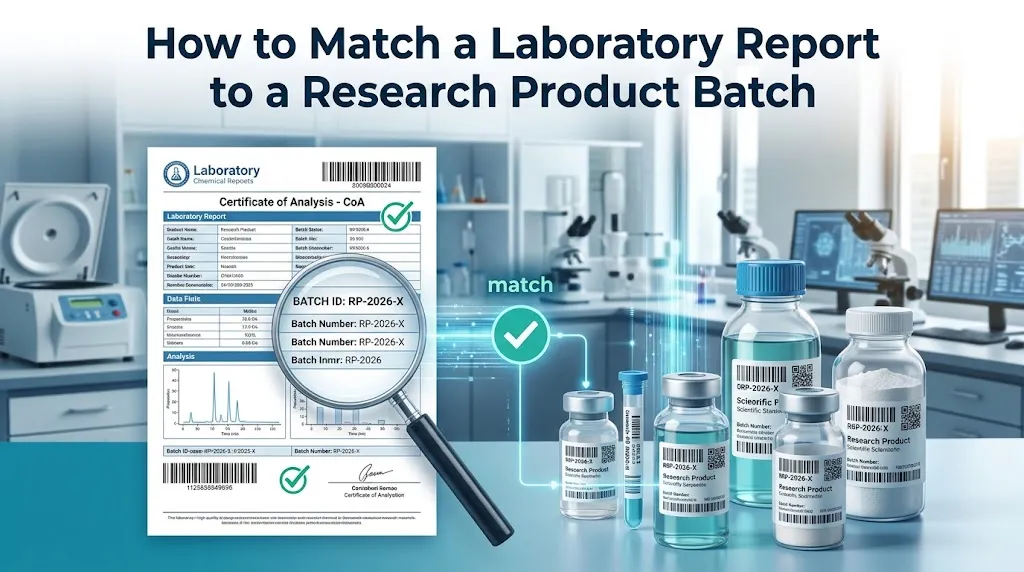





Laboratory reports are useful only when their connection to the relevant research material is clear. A report may contain analytical findings, sample references, and testing details, but researchers must still establish whether the document corresponds to the product batch they have received.
For laboratories sourcing research materials in the UAE, matching reports with product batches is an important part of documentation control. Remy Research provides a reference point for reviewing research material information and associated laboratory records.
All materials discussed in this article are intended strictly for in-vitro laboratory research only. They are not intended for human or veterinary use.
1. Understand the Difference Between a Product and a Batch
A product name identifies a material category or listing. A batch number identifies a particular group of material within a supplier’s recordkeeping system.
Two materials may share the same product name but have different batch identifiers. Their associated records should therefore be reviewed separately.
For example, a laboratory may receive the same listed research material during two different procurement periods. If the supplier assigns separate batch references, the documentation for each batch should be maintained independently.

Researchers should avoid treating a product name as proof that two separate supplies have identical documentation or analytical histories.
2. Start With the Product Label
The first step is to review the product label or packaging information.
Record the details that are actually visible, such as:
- Product or material name.
- Batch or lot number.
- Supplier reference.
- Product format, where stated.
- Other identification details.
The information should be recorded exactly as presented. If a label is unclear, incomplete, or difficult to read, the discrepancy should be documented rather than corrected through guesswork.
3. Locate the Corresponding Laboratory Report
Once the product information has been recorded, identify the laboratory report that the supplier associates with the material.
The report may include a sample reference, batch identifier, product description, or report number.
Compare the available details with the label and supplier records.
A useful matching process should establish whether:
- The product descriptions are consistent.
- The batch references match, where both are provided.
- The laboratory sample reference is identifiable.
- The supplier has explained any difference between identifiers.
- The report’s stated scope is relevant to the material received.
If the report does not contain the same batch number as the packaging, ask the supplier to explain the relationship between the tested sample and the supplied batch.
4. Distinguish Sample Numbers From Batch Numbers
A sample number and a batch number are not necessarily interchangeable.
A laboratory may assign its own identification number when a sample is submitted for analysis. The supplier may use a different identifier for the associated material batch.
Both identifiers can be valid, but the connection between them should be documented.
For effective recordkeeping, laboratories should maintain a reference that connects:
- The received product.
- The supplier’s batch identifier.
- The laboratory’s sample identifier.
- The corresponding report number.
This creates a traceable record without assuming that the identifiers represent the same thing.
5. Check the Report Date
The date on a laboratory report provides context about when the analysis was performed or documented.
It should be compared with the relevant supply and receipt records.
A report from an earlier period may still be useful for understanding a previously tested sample. However, it should not automatically be treated as confirmation of a later batch.
When reviewing dates, consider:
- The sample testing date, if stated.
- The report issue date.
- The date the material was received.
- The batch or lot reference associated with the report.
- Any supplier explanation of the relationship between the tested sample and supplied material.
A date comparison can reveal when further clarification is needed.
6. Review the Scope of the Analytical Report
A laboratory report describes the analysis performed on the identified sample. Its conclusions should be interpreted within that scope.
For example, an HPLC report may present chromatographic information for a submitted sample. An LC-MS report may provide mass-related analytical information for that sample.
Neither report should automatically be extended to other batches or product formats without supporting documentation.
Researchers should check whether the report clearly identifies:
- The sample analysed.
- The analytical method used.
- The reported findings.
- Any limitations stated by the laboratory.
- The material or batch to which the findings are being associated.
This helps prevent broader claims than the available evidence supports.
7. Understand Supplier-Provided Batch Mapping
In some supply systems, a supplier may associate one tested sample with multiple product listings, formats, or strengths.
This is commonly described as supplier-provided sample or batch mapping.
The mapping may help explain how the supplier organizes its product documentation. However, it does not necessarily mean that every associated format has been independently tested.
A clear record should distinguish between:
- A sample directly analysed by a laboratory.
- A batch reference assigned by the supplier.
- Other formats associated through supplier mapping.
- Separate reports available for additional samples or batches.
Researchers should preserve this distinction when filing or discussing analytical records.
8. Create a Report-to-Batch Matching Record
A simple internal record can make the matching process more consistent.
Laboratories may use a table containing the following fields:
| Record Field | Information to Capture |
| Product name | Description shown on the label |
| Supplier | Name of the supplying organization |
| Batch or lot number | Supplier-assigned reference |
| Sample number | Laboratory-assigned reference |
| Report number | COA or analytical report identifier |
| Testing method | Method stated in the report |
| Report date | Date shown on the document |
| Receipt date | Date material entered laboratory inventory |
| Mapping notes | Explanation of any supplier-provided association |
| Review status | Matched, clarification required, or unresolved |
The record should contain only information supported by the available documents.
9. What to Do When Identifiers Do Not Match
A mismatch does not always mean that a report is unrelated to the material. Different organizations may use separate identification systems.
However, the relationship should not be assumed.
When identifiers differ, laboratories can:
- Record the exact identifiers shown on both documents.
- Identify which information is inconsistent or missing.
- Request written clarification from the supplier.
- Ask for supporting batch-mapping information, if applicable.
- Retain the clarification with the relevant report.
- Mark the record as unresolved until the relationship is sufficiently explained.
This approach creates a clear audit trail and avoids silently changing document information.
10. Common Report-Matching Mistakes
Several mistakes can weaken the reliability of laboratory records.
Matching by product name alone: Similar product names do not establish that reports relate to the same batch.
Ignoring sample identifiers: A laboratory sample number may be essential to understanding the report’s scope.
Treating old reports as current: An earlier report does not automatically establish the characteristics of a later supply batch.
Assuming every format was tested: Supplier mapping should not be presented as independent testing unless separate evidence supports that conclusion.
Changing identifiers manually: Original references should be preserved exactly as shown in the source documents.
Avoiding these mistakes makes documentation easier to review and maintain.
11. Documentation Transparency in the UAE
Laboratories sourcing Peptide Supplier UAE information should look for clear explanations of how supplier batch references connect with available analytical reports.
A transparent documentation process should make it possible to identify the tested sample, understand any supplier-provided mapping, and recognize where the report’s scope ends.
Where information is incomplete, written clarification is preferable to assumptions based on product descriptions or marketing statements.
12. Final Matching Checklist
Before marking a laboratory report as matched to a product batch, review the following:
- Product description has been recorded.
- Packaging batch number has been captured.
- Supplier batch reference is identifiable.
- Laboratory sample number has been reviewed.
- Report number and date are recorded.
- Analytical method is identified.
- The report’s sample scope is understood.
- Any supplier-provided mapping is clearly documented.
- Differences between identifiers have been explained.
- Unresolved discrepancies remain clearly marked.
This checklist can support a consistent internal procedure for laboratory procurement and material recordkeeping.
Conclusion
Matching a laboratory report to a research product batch requires more than comparing product names. It involves reviewing identifiers, dates, sample references, supplier records, and the stated scope of analytical testing.
For research laboratories, a consistent matching process helps maintain traceability and reduces the risk of applying one sample’s analytical findings to unrelated materials. Clear records and written supplier clarification are essential whenever the relationship between a report and a batch is uncertain.
All materials discussed in this article are intended strictly for in-vitro laboratory research only and are not intended for human or veterinary use.

