





When someone dies without a registered Will in Dubai, their estate doesn’t automatically go to their spouse or children, the way many expats expect. Instead, Sharia law takes over, and the results can be surprising, even for non-Muslims.
In this guide, we explain how Sharia law impacts inheritance when someone dies intestate (without a Will) in Dubai, what that means for expats living in the UAE, and why planning with a legally registered Will is more important than ever.
What Happens When You Die Without a Will in Dubai?
When a person passes away in the UAE without a registered will, their estate is placed under court supervision until inheritance matters are resolved. For Muslims, distribution is governed by Islamic inheritance principles under Federal Decree-Law No. 41 of 2024. For non-Muslims who have not registered a will, the courts may still apply Sharia-based rules or civil-law provisions depending on the circumstances, creating uncertainty for families.
At this stage, bank accounts may be frozen, property transactions are paused, and family members cannot freely access assets until the court determines how everything should be divided. Importantly, there is no assumption that the surviving spouse inherits everything, and children do not necessarily receive equal shares.
This is one of the key reasons Wills in Dubai for expats are strongly recommended. Without one, inheritance outcomes are determined by law, not personal wishes.
Fixed Shares Under Sharia Law
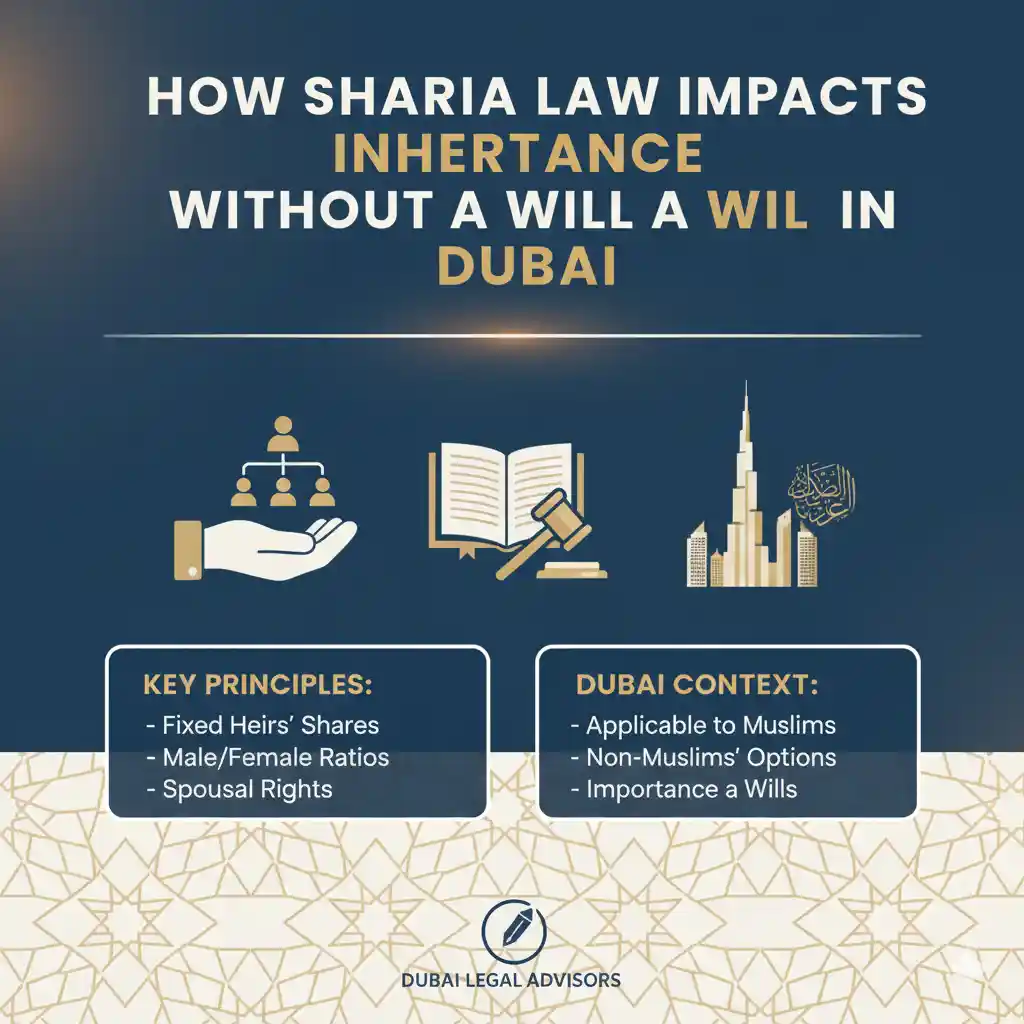
Sharia inheritance law works on a system of fixed shares assigned to different categories of heirs. These shares are not flexible and do not take personal circumstances or preferences into account.

Typically:
- A surviving spouse receives between 1/8 and 1/4 of the estate, depending on whether the deceased had children.
- Sons usually inherit twice the share of daughters, reflecting traditional Islamic succession rules.
- Parents may inherit a portion of the estate, even if the deceased had a spouse and children.
- In certain cases, extended relatives such as siblings, paternal uncles, or cousins may also have legal claims.
Recent legal reforms have helped clarify procedures and improve efficiency, but the underlying structure of Sharia inheritance remains intact. The estate is divided among multiple heirs rather than passing fully to a surviving partner, which often conflicts with the expectations of expatriate families.
How Recent Legal Changes Affect Non-Muslims
In recent years, the UAE has introduced reforms aimed at providing greater flexibility for non-Muslim residents. In some circumstances, courts may apply civil-law principles when no Will exists, particularly for non-Muslims. However, this does not eliminate uncertainty.
Without a registered Will, families may still face:
- Delays caused by court interpretation
- Jurisdictional complexity across emirates
- Outcomes that differ from what the deceased would have wanted
This is why relying on default inheritance rules is risky, even with recent updates. The most reliable way to retain control is through a Dubai Will that clearly sets out how assets should be handled.
How to Protect Your Estate in the UAE
The good news is that expats have clear legal pathways to override default Sharia-based inheritance and take control of their estate planning.
A properly registered UAE Will for expats allows you to:
- Decide exactly who inherits your assets
- Ensure your spouse is fully protected
- Appoint guardians for minor children
- Prevent unnecessary legal disputes and delays
This applies whether your assets include property, savings, investments, or business interests.
Registering a Will in Dubai and Abu Dhabi
One of the most effective ways to protect your estate is by registering a Will through recognised authorities in the UAE. These Wills are legally enforceable and apply across all emirates.
There are two main options:
DIFC Wills Service Centre
This option is commonly used for Wills in Dubai and is suitable for expats with assets such as real estate, bank accounts, or businesses within the UAE.
Abu Dhabi Judicial Department (ADJD) Wills
This is another widely accepted route that offers coverage across the UAE and operates under civil-law principles. Many residents choose this option due to its clarity and nationwide recognition.
To understand more about how Wills work in Abu Dhabi and Dubai, and to start your planning, check out our Abu Dhabi Will registration.
Final Thoughts: Don’t Leave It to Chance
Whether you live in Dubai, Abu Dhabi, or elsewhere in the UAE, dying without a Will can expose your family to uncertainty, delays, and complexity. For Muslims, Sharia rules are structured and rooted in tradition; for non-Muslims, civil defaults offer equality but limited flexibility.
By registering a proper Will in Abu Dhabi or Dubai, you take control of your legacy, protect loved ones, and ensure assets are handled as intended.
Whether you’re Muslim or non-Muslim, MakemyWill makes it simple and affordable to create a legally binding Will that protects your assets, appoints guardians for your children, and ensures your wishes are honoured.
Related Reading: Is a Power of Attorney in Dubai Legally Recognized for Property Transactions?
Related Reading: AC Gas Refill in Dubai: Cost, Process & When You Need It — full guide
Related Reading: Web-Application Development in Dubai- The Ultimate Guide for 2026 & Ahead
Related Reading: Salon & Beauty Clinic Fit-Out Services in Dubai: Creating Luxurious Customer Experiences — full guide
Related Reading: Fabric Studio: The Advantages of Renting a Photo Studio in Dubai — full guide
Related Reading: What Should You Do If Arrested in Dubai? — full guide
