






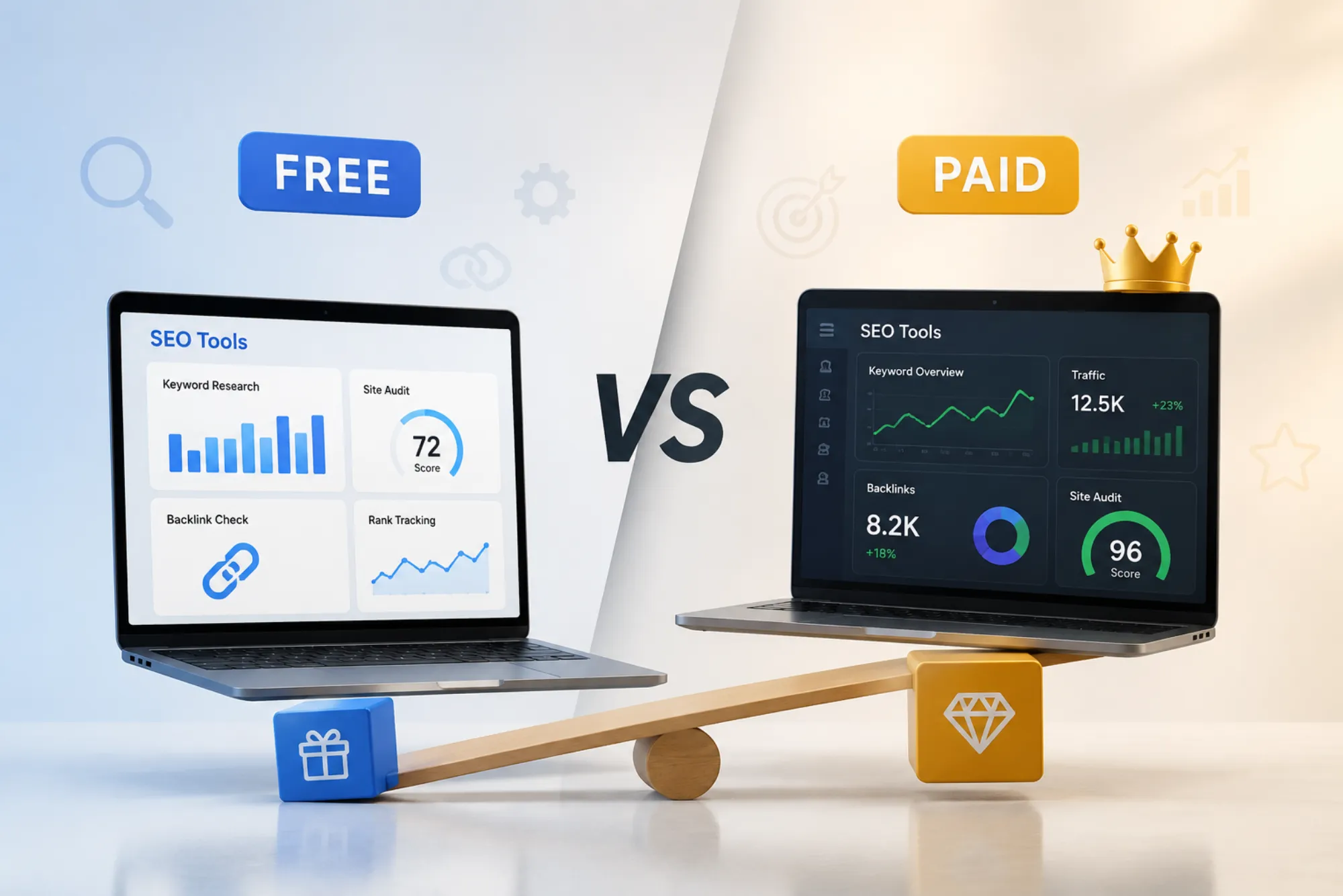
SEO agencies in 2026 are operating in a far more competitive environment than they were just a few years ago. Search algorithms are evolving faster, AI-generated content is flooding search results, and clients expect deeper reporting with measurable ROI. Under those conditions, choosing between free and paid SEO tools is no longer a minor operational decision. It directly affects scalability, efficiency, reporting accuracy, and client retention.
Many smaller agencies and freelancers still rely heavily on free SEO platforms to reduce operating costs. Meanwhile, established agencies often invest thousands annually into enterprise-grade SEO suites. The challenge lies in understanding when free tools are enough and when paid platforms become a necessity rather than a luxury.
For most agencies, the right answer is not strictly free or paid. The smarter approach usually involves combining both strategically based on workflow, client size, reporting requirements, and growth goals.
Commercial investigation search intent dominates this topic because agencies are typically comparing capabilities, costs, limitations, and long-term value before deciding which SEO stack to adopt.
What Free SEO Tools Can Still Do Well in 2026
Free SEO tools remain surprisingly useful for foundational optimization work. Search engines themselves continue to provide valuable resources, while several browser-based platforms offer limited but practical functionality for research and audits.
For startups, solo consultants, and boutique agencies with a small client base, free tools can cover essential SEO activities such as:

- Basic keyword research
- On-page SEO analysis
- Technical SEO checks
- Search performance monitoring
- Backlink overview reports
- Core Web Vitals testing
- SERP preview analysis
Platforms like Google Search Console and Google Analytics still form the backbone of organic performance tracking. They offer direct insights from Google itself, making them highly valuable despite costing nothing.
Free tools also help agencies validate strategies before investing in expensive subscriptions. A new agency testing local SEO campaigns, for example, may not immediately require enterprise-grade crawling or competitive intelligence software.
Where Free SEO Tools Start Becoming Limiting
As agencies scale, operational bottlenecks become increasingly visible. Free tools are often designed for individual website owners rather than teams managing dozens of campaigns simultaneously.
The biggest limitation is fragmentation. Agencies using only free solutions usually jump between multiple platforms to complete one task. Keyword research might happen in one tool, technical audits in another, and reporting somewhere else entirely.
That fragmented workflow creates several problems:
- More manual work
- Higher reporting inconsistencies
- Reduced automation
- Limited competitor tracking
- Difficulty scaling client management
- Restricted historical data access
Another major issue is data depth. Most free SEO tools intentionally restrict exports, search volume visibility, ranking history, or backlink intelligence. Agencies handling competitive industries often find these limitations unacceptable.
Teams working on larger campaigns also require collaborative dashboards, client access permissions, white-label reports, and automation features that free tools rarely provide.
What Paid SEO Tools Offer Agencies in 2026
Paid SEO platforms are increasingly becoming workflow ecosystems rather than standalone research tools. Modern agency-focused platforms integrate AI analysis, automation, reporting, forecasting, technical audits, and collaboration systems into one environment.
Instead of simply collecting keyword data, premium SEO software now helps agencies prioritize opportunities, predict ranking trends, identify content gaps, and automate recurring reporting tasks.
Most paid SEO tools deliver advantages in five major areas:
| Feature Area | Free Tools | Paid SEO Platforms |
|---|---|---|
| Keyword Data Depth | Limited | Comprehensive databases |
| Backlink Analysis | Basic overview | Advanced competitor intelligence |
| Automation | Minimal | Extensive workflow automation |
| Client Reporting | Manual | White-label dashboards |
| Scalability | Limited | Built for agency growth |
Premium SEO suites also improve efficiency dramatically. A task that takes three hours manually using free platforms may take fifteen minutes using an integrated paid system.
That time difference matters because agencies ultimately sell expertise and execution capacity. Saving operational hours directly impacts profitability.
Cost Comparison: Free vs Paid SEO Tools
Cost is often the deciding factor, especially for small agencies. However, evaluating SEO software purely on subscription price can be misleading.
Free tools may appear cost-effective initially, but they often create hidden operational expenses through manual work, slower execution, and inconsistent reporting.
Paid platforms vary significantly depending on features, user limits, and data access levels.
| Agency Type | Typical Tool Setup | Estimated Monthly Cost |
|---|---|---|
| Freelancer | Mostly free tools | Low or none |
| Small Agency | Mixed free and paid stack | Moderate subscription costs |
| Mid-Sized Agency | Professional SEO suite | Higher monthly investment |
| Enterprise Agency | Multi-platform enterprise setup | Large operational software budget |
Pricing structures also changed considerably by 2026. Many platforms now charge based on:
- Tracked keywords
- Number of projects
- User seats
- API access
- AI analysis credits
- Reporting volume
Before committing to a premium platform, agencies should carefully calculate the actual operational savings generated by automation and consolidated workflows.
Which Agencies Benefit Most From Free SEO Tools?
Free SEO software still makes sense in several practical situations. Agencies with limited clients or highly specialized service offerings can often operate effectively without expensive subscriptions.
Free tools are usually sufficient for:
- Freelancers handling fewer than five SEO clients
- Local SEO consultants
- Content-focused agencies
- Agencies validating new markets
- Short-term SEO projects
- Learning and training purposes
Agencies focusing heavily on local optimization may rely more on manual expertise than massive data analysis. In those cases, operational simplicity matters more than enterprise-level functionality.
Smaller teams can also maintain closer oversight over campaigns manually, reducing the need for automation.
When Paid SEO Tools Become Essential
Growth changes everything for agencies. Once client numbers increase, workflow inefficiencies become expensive.
Paid SEO platforms become almost essential when agencies need:
- Scalable reporting systems
- Large-scale keyword tracking
- Competitor monitoring
- Automated site audits
- Team collaboration features
- API integrations
- Historical SEO data
- White-label deliverables
Agencies serving e-commerce, SaaS, finance, or highly competitive sectors especially benefit from premium datasets and advanced SERP analysis.
Comprehensive technical SEO visibility is another major reason agencies upgrade. Large websites with thousands of pages require advanced crawling and prioritization systems that free tools simply cannot provide effectively.
The Hybrid Approach Most Agencies Are Adopting
Many successful agencies now use hybrid SEO stacks instead of relying entirely on either free or paid tools. This approach balances operational efficiency with cost control.
A common workflow might combine:
- Google Search Console for search performance data
- Free browser extensions for quick audits
- A paid rank tracking platform
- Premium backlink analysis software
- Automated reporting tools
This layered strategy prevents overspending while still maintaining professional reporting standards.
Agencies that invest strategically rather than emotionally often achieve better long-term margins. Purchasing every available SEO platform rarely improves campaign quality proportionally.
AI and Automation Are Changing the SEO Tool Landscape
The rapid expansion of AI-driven SEO systems is one of the biggest developments shaping agency decisions in 2026. Modern SEO platforms increasingly integrate predictive analysis, automated content recommendations, and anomaly detection.
Paid tools generally lead this innovation because advanced AI infrastructure requires significant development investment.
Some AI-powered SEO features now include:
- Automated internal linking suggestions
- Search intent clustering
- Technical issue prioritization
- AI-assisted content optimization
- Competitor gap analysis
- SERP volatility tracking
Agencies focused on efficiency and scalability are increasingly prioritizing automation tools that reduce repetitive manual tasks.
Industry discussions around SEO automation continue evolving rapidly, particularly as AI-generated search experiences become more prominent. Agencies monitoring these shifts often reference broader SEO research and evolving search trends from industry publications such as [Insert relevant reference link here].
How Agencies Should Evaluate SEO Tools Before Buying
Choosing SEO software based solely on popularity can lead to expensive mistakes. Agencies should evaluate platforms according to operational fit rather than brand recognition.
Before subscribing, agencies should assess:
- Client volume and growth projections
- Reporting requirements
- Team size and collaboration needs
- Technical SEO complexity
- Integration compatibility
- Automation opportunities
- Data accuracy requirements
- Budget sustainability
Trial periods are especially valuable because workflows vary dramatically between agencies. A platform that works perfectly for enterprise reporting may feel unnecessarily complex for a smaller local SEO consultancy.
Agencies should also calculate onboarding time. Some enterprise-level SEO systems require significant training before teams can use them efficiently.
Common Mistakes Agencies Make With SEO Tool Investments
Many agencies overspend on SEO software long before they actually need enterprise-level functionality. Others underinvest and struggle with operational inefficiency as they grow.
Common mistakes include:
- Paying for overlapping tool features
- Ignoring workflow compatibility
- Choosing tools based on hype
- Failing to train teams properly
- Relying entirely on automation
- Underestimating reporting requirements
Another frequent problem is subscribing to large platforms without fully utilizing available features. Agencies often pay for capabilities they never actually implement operationally.
A focused SEO stack aligned with specific business goals usually performs better than a bloated collection of disconnected subscriptions.
Frequently Asked Questions
Are free SEO tools accurate enough for agencies?
Free SEO tools can provide reliable foundational data, especially from platforms like Google Search Console. However, they often lack deeper competitive analysis, advanced automation, and large-scale tracking capabilities required by growing agencies.
Do small SEO agencies need paid tools?
Not always. Small agencies with limited clients may operate effectively using a combination of free tools and a few affordable premium solutions. The need for paid software usually increases with client volume and reporting complexity.
What is the biggest advantage of paid SEO tools?
The biggest advantage is efficiency. Paid platforms centralize workflows, automate repetitive tasks, and provide deeper data insights that help agencies scale operations more effectively.
Can agencies combine free and paid SEO tools?
Yes. Many successful agencies use hybrid setups that combine free tools for foundational analytics with paid platforms for advanced reporting, automation, and competitor analysis.
Are AI-powered SEO tools replacing traditional SEO platforms?
AI features are becoming integrated into traditional SEO platforms rather than replacing them entirely. Most agencies now use AI-assisted workflows alongside standard technical SEO and analytics tools.
Conclusion
The debate around free vs paid SEO tools for agencies is ultimately less about cost and more about operational maturity. Free tools remain highly valuable for foundational SEO work, early-stage agencies, and lean workflows. Paid platforms, however, become increasingly important as agencies scale, automate reporting, manage larger datasets, and compete in demanding industries.
In 2026, the most effective agencies are rarely using only free or only paid solutions. Instead, they build balanced SEO ecosystems that align with client expectations, workflow efficiency, and long-term growth objectives.
Choosing the right SEO stack requires a realistic understanding of current operational needs rather than chasing software trends. Agencies that invest strategically in the right mix of tools typically gain stronger efficiency, better reporting capabilities, and improved scalability without unnecessary overhead.
Related Reading: Mortgage vs Developer Payment Plans: Which Saves More?
Related Reading: Affordable SEO Tools for Agencies on a Practical Budget in 2026
Related Reading: Why More Families Are Choosing Home-Based Medical Care
Related Reading: What Makes a Handheld Laser Welder Different?
Related Reading: Best All-in-One SEO Tools for Agencies in 2026: What to Use and Why

